Monday, October 23, 2006

Lights, Camera, Ekshin...

Tara tells me that when the movie Little Buddha was filmed in Kathmandu, there were hundreds of local extras hired to hang out and do Buddhist things around the temple in Bodda. Once everyone was in place the Italian director said the usual "lights, cah-mera, ekshin!" But nobody moved. They tried it again. Again everyone froze. Ahh, but in the Nepalese language, ekshin means wait.

As any filmmaker knows, there's a lot of waiting, which can try the patience of the people involved. We wait for light, we wait for quiet, we wait for instruments to be tuned and retuned. We wait for the kids to stop shouting, "You want us to be quiet!?" We pay grandma to take the kids as far away from the microphones as possible. We wait while we chase off the crowds of neighbors who walk by and spit loudly during the quiet part of the song.

We wait to keep our group together. 4 Americans, 3 Nepalis, 2 Indians, 1 driver plus whichever musicians we're working with that day. It's like herding kittens, but so far so good, and more fun than I'd expected. Here's how it's gone so far...

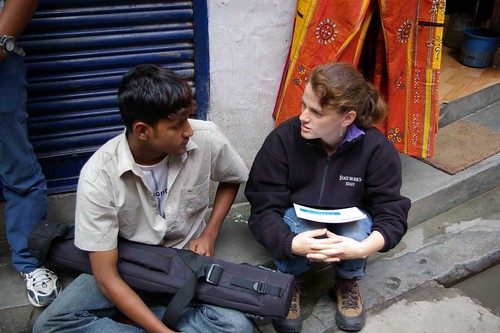
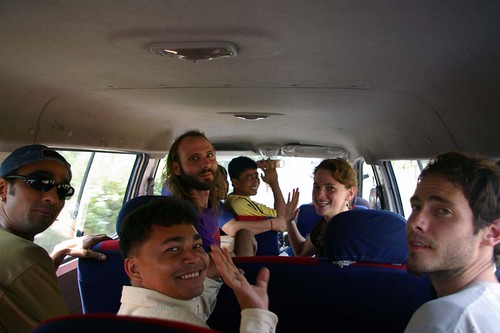
On Friday the 13th, at 7AM we drop a few bags in storage and meet the van driver out in front of our hole-in-the-wall guesthouse. The filmmakers have arrived from New Dehli. Praveen Singh and his friend Sanjeev Monga. At first I was a little reluctant to take a second film guy, after all it's another mouth to feed. But Monga has proved to be essential; enthusiastic and nearly invisible behind the camera; very important when dropping a crew of foreigners on the old people's doorsteps. Tara, Danny, Dan, Praveen, Monga, Buddhiman, Manoj, Ganesh, myself and the driver pile in the Kia minibus and weave through the crowded streets and out of the Kathmandu smog.

The drive is gorgeous, snaking along towering Himalayan "foothills," pregnant rivers after the monsoons, clean air and small brightly painted Nepali towns. We climb the road to Gorkha, and it's a relief to see the town without the curfews and police presence I've seen there in 2002 and earlier this year. Some Maoist rebels killed about a hundred soldiers and policemen in Nepal's ancient capital a few years back, but with the Maoist ceasefire still holding and negotiations underway, it's a refreshing to see Nepal at peace.

Wednesday, October 11, 2006

Rehearsal


The negotiations got a bit ugly, the higher-ups within the GCAO feeling left out of the fun (and money), but we smooth things out with a donation to a children's emergency scholarship fund. Huge thanks to all the folks in Bozeman who came out to the Filling Station last month. You saved us and sent some kids to school this year!

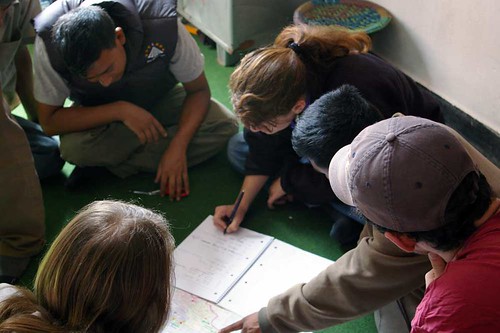
I spend the morning with Ganesh and Manoj, buying notebooks, pencils, fountain pens, ink, erasers, sharpeners, and most boringly important, a book of blank receipts in Nepali and English script, so the IRS doesn't put me away when I get back home.

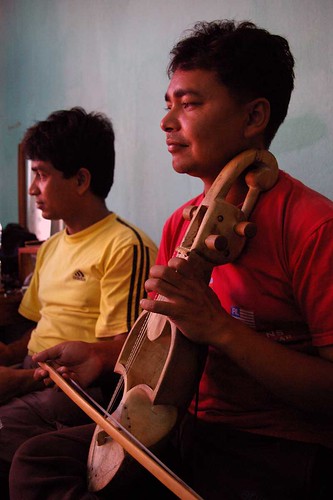
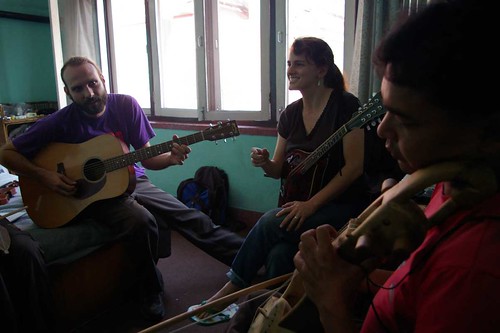
Nice to know we're helping some poor folks out, but I'm counting the days until we can get out of Kathmandu. We still have another day before Praveen the cinematographer arrives from New Dehli, so with the school supplies purchased, the van squared away, and the bureaucrats satisfied, it's time to get back to the music. In addition to helping out the kids and documenting the old folks, we're also gonna try to record an album mixing Nepali and Appalachian folk songs. This takes more work than you'd think and so the rehearsals have started. Here's Tara, Danny, Buddhiman and Manoj as they test the waters on this Old-Time Himalayan Bluegrass thing...

(my apologies for the low-rez footage-this was shot on a point-and-shoot digital camera). The real filming/recording begins in two days. We've got two months with these guys, as well as the old-timers playing the real backwoods Himalayan music. We're just getting started.


Monday, October 09, 2006

Negotiations

I'm sitting at the table with a potential minivan driver. He just asked for a month's wage...per day. We chuckle and proceed to bargain, each coming up with extraordinary excuses and justifications and in the end settling for nearly 10 times more than I'd budgeted (but better than 20).

On previous trips, I've always just taken the bus around Nepal, but we want to be out in some rural areas for about 3 weeks with lots of fragile gear, and anyway nobody else really wants to take the bus, which is dangerous, uncomfortable, and unlikely to have 9 seats available during festival season. (9 people? Where did that guy come from?) Despite my best bargaining efforts, our expedition budget has just devoured my plane-ticket-home-budget. But that's next month's problem...

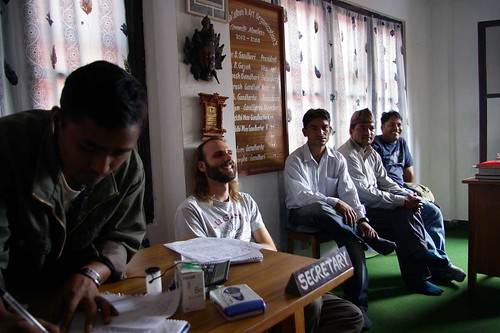
The last few days have been spent writing last-minute grants in internet cafes and negotiating logistics in the Gandharbas' office. The Gandharbas might make around 40 US dollars a month, so they're all there waiting to be invited along on the foreigners' expedition. In the office it's a barrage of ideas from everybody who can make it in the door. We're here to help, but also have to keep the scams to a minimum.

500 rupees per person per day for food and lodging? Are you mad?

Ok, 250.

Tik-cha, tik-cha...

How many pencils? How many notebooks? No way, notebooks do not cost that much. How much should we pay the elderly musicians we record? Absolutely not, the driver does not get to bring a friend. How many pieces of clothing does each family get?

Which villages should we visit? Archale? Never heard of it. Are there any musicians there? Your grandfather? Can he still play? How much diesel to get there and back? Ok, we can go. If I don't shave do you think they'll charge me as a foreigner in the National Park?

Which Gandharbas will get to be our paid guides and translators? They look a little disappointed as we whittle the number down from 5 to 3. Guess we're not as rich as the Americans on TV.

We choose Buddhiman from Lamjung, the best sarangi player, Ganesh from Gorkha, the best translator, and Manoj from the Terai lowlands, the best singer and multi-instrumentalist. The president of the GCAO, a great guy in his own right, is gonna feel stiffed, but he doesn't really have much to offer outside the office. And besides, we need people with contacts in the different regions we're going. The ones who go will get some cash for their efforts, so it's got to feel lousy to not get picked. It will take some tight-rope wheel-greasing diplomacy over the next few days not to offend our hosts. We have to tell the president of the organization that he is unfortunately no longer invited. He loses face but takes it like a champ.

After four years in planning, you'd think we'd have had everything taken care of. Generous donors, fundraising concerts, a nice grant from a charitable foundation, hours of budgets and logistics and graphic designing. In the end one's expectations and those nice rounded figures get thrown to the wind.

The good news is that we're gonna pull off a good 3 weeks of filming and recording in some remote villages with some cool people. Tara and Danny are teaching a few musicians the Appalachian tunes, and we're definitely helping the Gandharbas out, teaching them how to make their own audio recordings, providing an emergency scholarship fund for those who almost have enough to go to school this year (many Gandharbas I've met average a 3rd grade education level), and giving out about 50 pounds worth of Salvation Army clothing. But no matter how many smiles and itemized receipts I get, the bottom line is that I'm gonna eat it on this one. Hope the footage is good.

Across the street as I type this there is a rather fat monkey using the telephone lines as a traffic lane, swinging across the street and has nicely managing to sever the internet connection. A couple of red-robed Tibetan monks chuckle as he untangles himself from the cables. I love Nepal...


Friday, October 06, 2006

OK, checklist...

Let's see there's close to 400 pounds in our overstuffed bags: a few hundred gigabytes of hard drive space, blank DVD-R's, way more DV tapes than you're allowed to bring into Nepal, various cameras, microphones, audio recorders, mixers, cables and adaptors, batteries, tripods, mic stands, banjo, fiddle, mandolins, guitars, a very tired laptop, plastic bags for waterproofing, water filter for drinking, assorted pharmaceuticals from Thailand, phrasebooks, passports, visas, ATM cards, hijacked airline blankets, heaping piles of children's clothing to be donated, and as many napkins (toilet paper) as we can pocket. So much for traveling light.

A late addition to the team is Dan Snyder, a Montana guitarist who's volunteered to help out in turn for getting to meet lots of musicians and maybe make his way to Dharmasala when we're done with our work in Nepal. It's his first time out of North America and he's adapting splendidly to the local insects.

Over the last two weeks Dan and I have been doing the whirlwind tour of Northern Thailand; meeting old Burmese friends in the border town of Mae Sot, playing Gypsy Swing with French aid workers, spending a night at our friend's orphanage near Tat Song Yang, giving a seminar about world music at a school for Burmese migrants, taking lessons on the Pin Pia up in Chiang Mai, and recording guys like my good friend Win. Here's one of his songs.

But that's another story. We meet Tara and Danny at the airport in Bangkok, and fly into Kathmandu the next afternoon, Everest and other Himalayas glowing to the north as the plane drops into Kathmandu valley. The low concrete buildings are a massive contrast to the glittery architecture of Bangkok.

Our minivan driver is happy that peace has returned to Nepal after several years of violent Maoist insurrection and general mismanagement by the king. The tourists are flowing back to the narrow streets of Thamel, a funky hippie/tourist district where Nepalis dress like Westerners and Westerners dress like Himalayan holy men; a perfect backdrop for our little musical marriage.

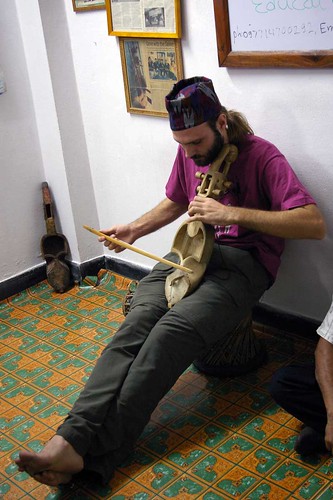
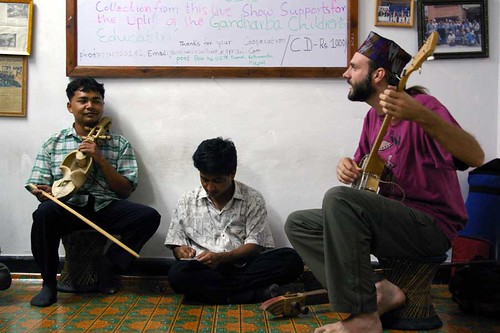
We drop our bags off at a guesthouse and head off to meet our friends around the corner at the Gandharba Culture and Arts Organization. I'm trying to remember everyone's name as we greet each other and sit down to dig on some of that old-time himalayan bluegrass. The sarangi fiddles and madal drums lay a musical bed for cheerful singing and dancing in the florescent light of their makeshift stage. They hold a free concert every night, but lacking much in the way of advertising, it's only the odd musically-curious tourist who can navigate the narrow alley and up the darkened stairs to find it. Hopefully we can help the Gandharbas with that while we're here.


We eat some dahl baht and make plans to meet several times over the next week to decide how the scholarship money we've raised will be distributed, where we're going to film, what the new t-shirt design should look like, and generally how to make everybody happy over the next 2 months. We've got about a week to kill before Praveen, our cinematographer, arrives from New Dehli, plenty of time to burn CD's for the GCAO to sell, practice each others' songs, and teach a few of the Gandharbas how to use the minidisc recorder we brought for them.

Then we'll be off to Pokhara, Lamjung, Ghampesal, and Gorkha, where Akal Bahadur Gandharba lives. He's the guy from the video on the last blog update, and has a great scratchy style of sarangi-playing. With time (and internet connections) on our hands this week, I'll update this as often as I can, so let me know what y'all want to hear about (gear, language, traditional culture, how to eat rice with your bare hands...) and I'll see what I can do.

Wednesday, September 27, 2006

Old-Time Himalayan Bluegrass


In 2002 some friends and I were traveling through Tibet and Nepal recording traditional music and jamming with whoever we met; guerilla ethnomusicology if you will. We noticed that some of the Himalayan folk music in Nepal sounded alot like old-time Appalachian music. Not the Buddhist monk chants or Hare Krishna organ grinding; these folks were playing homemade fiddles and banjos, making moonshine, and singing about the same things you'd hear about in old-time and bluegrass songs. Himalayan Bluegrass? Have a listen or watch this quicktime video.

These folks are called the Gandharbas. They're a Hindu caste of musicians, sometimes called the singing messengers of rural Nepal. These wandering minstrels walk from hilltop village to hilltop village, play a couple tunes on your doorstep, tell you the news from the next town, and ask for some rice or a few rupees in return. Simple folk. Great musicians.

Now Nepal's seen some rough times lately. There was the royal family being assassinated by a heartbroken nephew. There was the King's brother cancelling parliament and ordering protesters to be shot. And then there's the Maoist insurgency, which has been going on for ten years, scaring tourists away (and their dollars, 40% of Nepal's GDP) and killing lots of police and soldiers along the way.


Lots of rural folk, like the Gandharbas, end up moving to the cities like Kathmandu, where other Nepalis consider them to be
Dalit, or "untouchables." Belonging to this lowest of Hindu castes means you can't enter anyone's house, and typically miss out on aid money to provide for your kids' education, etc. And Nepal's already pretty poor. I read once that in terms of the number of people, there is more poverty in the southern Himalayas than in all of sub-Saharan Africa.

Some Nepalis I met didn't have the basic education to know to keep their outhouse toilets away from their drinking water. In addition to being poor and lacking the means to improve their lives, lots of younger Gandharbas (as they move to the cities) aren't picking up their elders' instruments, so there's a decent chance some of the music will be lost within a generation.


We wanted to help our friends out. We teamed up with a non-profit group called Tundra Club and started learning how to write grants. We're pretty new at the charity game, but after a few years, we've raised enough dough from some generous Americans to go back to Nepal and work with a few Gandharbas in some methods of cultural preservation (like teaching them how to record their grandparents' songs). We've also got a couple bucks to help send a few of em to school. Finally, since we're gonna jam with our Himalayan fiddling friends, we're gonna film and record the whole shindig.

The people we've got on this project are amazing. From Virginia, there's
Danny Knicely, playing fiddle, mandolin, guitar, and maybe a little banjo. He's played with tons of the bluegrass greats, like Vassar Clements, Tony Rice, Sam Bush, and Bela Fleck, and even won the Telluride mandolin competition back in '95. We've got Tara Linhardt, a fantastic mandolinist who used to live in Nepal. Behind the camera, we've got Praveen Singh, whose wildlife films have graced Discovery and National Geographic Channels. And me? I'm Jacob Penchansky, but friends in Asia seem to always call me Jack. I'll be your host on this journey; I'm a wandering sound recordist, semi-competent radio producer, and occasional jug-band banjo player. You can read about my most recent ramble here.


You can listen for us on public radio and possibly some of the more culturally-friendly television programs in the next year, but for now, we're off to find some of the highest lonesome sounds in the world. Stay tuned in the next few months and we'll be sure to post some good tunes and spectacular photos.

If you or your Old-Time music/Nepali culture lovin' friends have some cash kicking around and you'd like to support our efforts, you can write a tax-deductible check to:


Tundra Club, 501(c)3


...and mail it to...

Mountain Music Project
c/o Tundra Club
686 Canyon View Road

Bozeman, MT 59715

Please include a memo for MMP on the check.

Questions? Comments? You can email us at mountainmusicproject@gmail.com.

I'll do my best to keep this here blog updated as we begin our recording expedition/homegrown aid organization/traveling shindig this October. Internet-willing, you'll be seeing and hearing alot more from us.


Namaste!